
/filters:quality(90)/fit-in/970x750/coros-web-faq/upload/images/8aa508973cf52c8b676a23bc315ccd1f.png)
We’ve all heard the stats of how most people abandon their New Year’s resolutions before spring arrives. As an unfortunate result, many people have dismissed the idea of setting resolutions at all. As humans, however, we need something to aspire to, that drives us forward and pushes us to elevate ourselves. We need goals.
The problem isn’t with intentions, it’s with how we frame them. Resolutions tend to be broad and vague. Goals, on the other hand, work best when they’re clear and actionable. So, this year, instead of setting generalized resolutions of what you hope to achieve, set a goal that will lead you to success.
Set S.M.A.R.T Goals
The first step in setting goals that will actually help you become who you want to be, is creating goals that are SMART: specific, measurable, achievable, relevant, and time-bound.
Specific: This is maybe the most important part of the acronym because it helps you to stick to your goal when the going gets tough. Vague goals like “work out more” are hard to maintain when life gets busy. You start to really deconstruct the fact the ‘more’ is all relative. Instead, commit to a specific amount, like “Run three times a week for at least 20 minutes.” With your COROS watch, you can track your workouts and scroll back in the app to see your consistency over time.
Measurable: Your brain craves progress. Set goals where you can measure your progress: increase your FTP, improve your pace on a specific loop, increase your watts per kilogram, or finish a race. Look through the COROS Training Hub and determine which metrics are going to be the most useful to measure. Whether it’s measuring your hours per week or FTP (or both), having it all in one place with COROS makes it easier.
Achievable: In order to actually stay true to your goal, it needs to be achievable. If you work a 40 hour per week job, then riding your bike for 3 hours every day is likely more than you can commit to. If you start small and achieve the goal, you’re more likely to add onto that goal in the future rather than to give up before you really got started. COROS makes this easier by estimating your current fitness and providing your optimal training load. Use this to see you where you currently are in your journey and decide how far you can go.
Relevant: The goal should feel relevant to you. As a coach, I often get asked “What should my goal be?” The truth is, I can guide you toward good goals, but I can’t write them for you. Goals need to be personal; if they don’t light a fire in you, they won’t last.
Time-Bound: The last piece of accountability is to put a time limit on it. We are experts at procrastination, and goals can drift just out of reach forever if we let them. Set a time limit to spark some urgency.

Build a Goal Pyramid
Once your goals are SMART, structure them into three tiers:
Outcome goals sit at the top of the pyramid. These are the goals that first come to mind for most people because they focus on the final result, such as winning a race, or achieving a goal time. These goals are the most motivating, but not fully within your control.
Performance goals sit in the middle of the pyramid. They focus on measurable benchmarks like pacing, training volume, or power output that support your outcome goal. The Training Hub even allows you to build out a workout plan and predict your Training Status & Base Fitness in the future so that you can make sure to reach where you want to go on time.
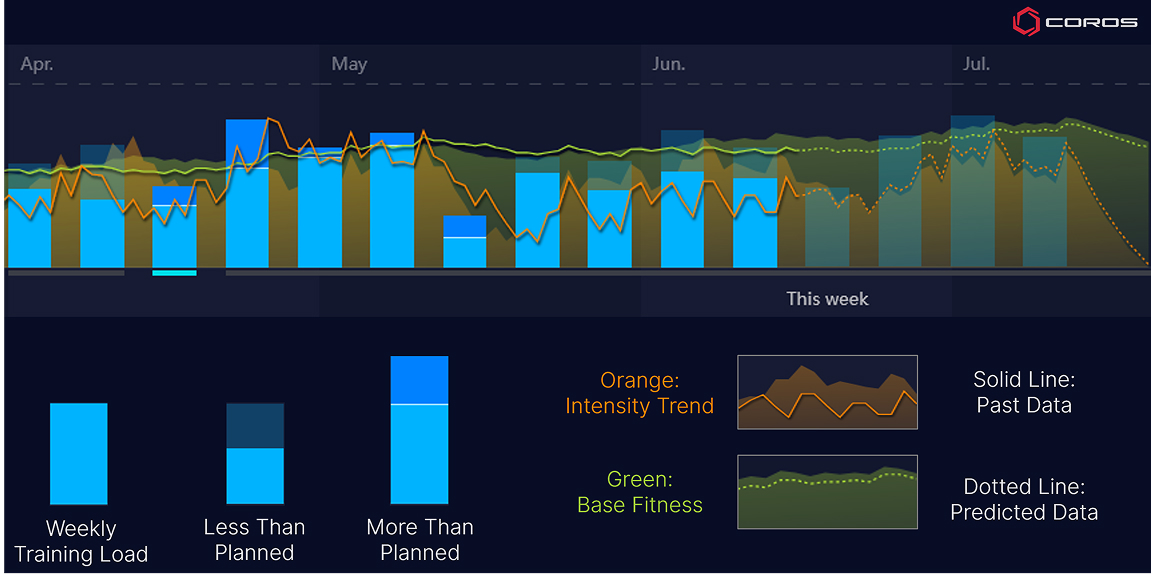
Training Hub can help you set and track your performance goals
Process goals are the techniques or strategies that you will use daily or weekly to meet those performance goals. These include things like drinking a certain amount of water per day, stretching for a specified time each day, or even committing to a sleep schedule. Tools like the COROS APEX 4 track your sleep patterns and recovery, giving you constant feedback on the process.
Set Short- and Long-Term Goals
You may have heard, “People overestimate what they can do in one year and underestimate what they can do in five.” This is absolutely true, and is why we need both short- and long-term goals. Short-term goals (weekly, monthly, quarterly) help you build confidence and maintain motivation. These small goals stack up over time and make your long-term goal more achievable. By following these principles, you’ll likely have to adjust and make your long-term goal even bigger than you first imagined.
Remember Your Why
There is an art to goal setting, but the biggest factor in achieving your goals is how much you want it. You won’t want it every minute of every day and you might not always enjoy the process, and you don't need to. On those days, it helps to remember why you started. Your “why” is your reason to keep going when the motivation dips. While strategies and structure are essential, your reason for starting often becomes your strongest source of drive.