/filters:quality(90)/fit-in/970x750/coros-web-faq/upload/images/e21d23067d06142b227654d2731241bc.png)
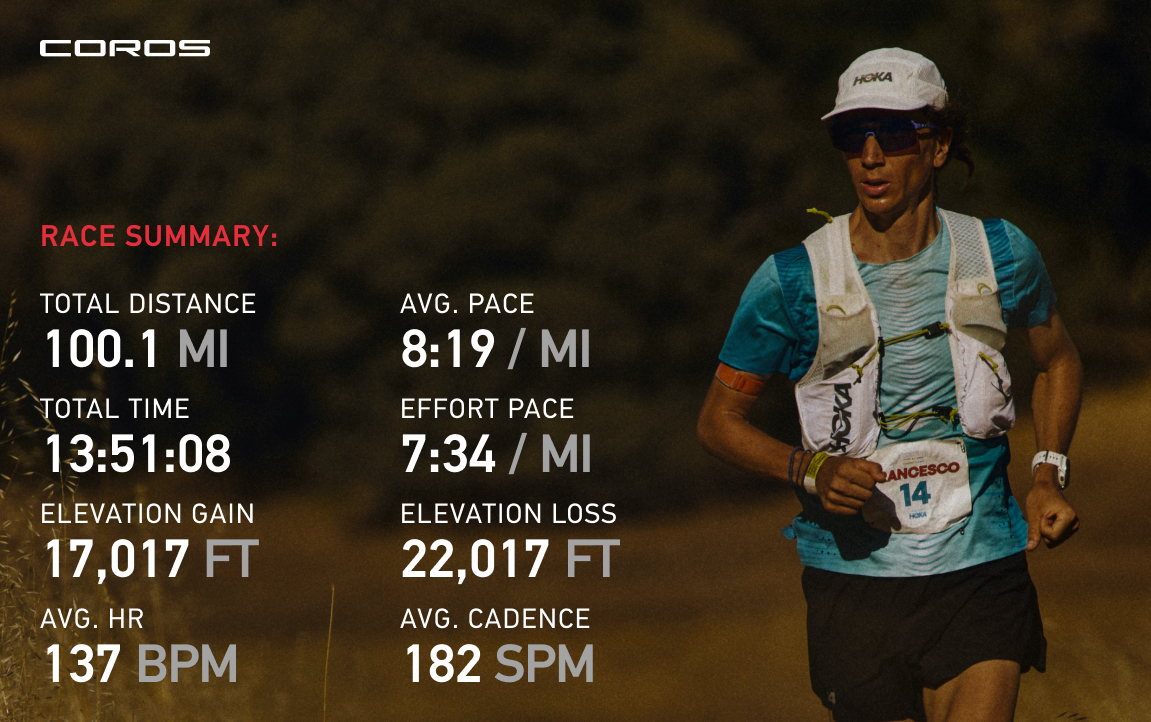
Francesco Puppi did not enter his first 100-mile race quietly. At the 2026 Western States 100, he ran 13:51:08, finished second, ran under the previous course record, and helped push the men's race into a new era. It was a debut only by distance, not by ambition.
Western States had never seen a men's podium fully under 14 hours. Francesco was part of that shift, finishing 4 minutes and 53 seconds behind Vincent Bouillard, whose exceptional late-race close earned him the win. For Francesco, the question was never whether he had the speed. With a 2025 Canyons 100K course record and a CCC victory behind him, he had already proven that. The question was whether that speed could survive 100 miles.
Turning Speed Into 100-Mile Endurance
Francesco's background made him one of the most interesting athletes on the start line. He is a runner shaped by track, short mountain races, fast trail racing, and long-distance problem solving. That matters at Western States, where the ability to keep running after hours of climbing and descending often decides the race.
In February, before Black Canyon 100K, Francesco explained how his preparation focused on speed, sustained running, and the ability to maintain high pace after many hours. Western States became the 100-mile test of that idea. His advantage was never only that he could run fast; it was that he could run fast at a lower relative cost, then still climb well when the course demanded it.
The performance also came after a disrupted preparation. At Black Canyon, Francesco dislocated his shoulder and had to drop. In March, he won Chianti Marathon and set a course record, but in early April he broke his wrist after falling on ice, and underwent surgery. Training remained relatively consistent outside of the short break around surgery, but his body was no longer responding well to the demands of a full 100-mile preparation.
“Because of the injuries and the stress and the fatigue coming with it, my body was not responding to training,” Francesco said. “It gave me a lot of uncertainty. You know how an easy run should feel, but I lost these sensations for a while.”
With his coach, Tito Tiberti, Francesco had to find another way to build the block. Instead of forcing a traditional 100-mile preparation, they used more cross-training, maintained a high overall training load, added more recovery between key sessions, and shifted the long runs toward endurance rather than intensity. The goal was to preserve the qualities he had already developed while gradually preparing his body for the mechanical demands of running 100 miles.
Around mid-May, the preparation began to turn. Francesco started to feel the training click again, allowing him to put together stronger workouts and more consistent weeks. The final month became less about chasing every specific stimulus and more about consolidating the work already done: maintaining speed, improving durability, and arriving at Olympic Valley with a body ready to keep running deep into unknown distance.
“I was concerned about the sessions that I was not able to keep in the mix of the training block, since it was a bit compressed compared to what me and my coach would have hoped for,” he said.
“We sacrificed some specific stimuli along the way, but with the way my season is structured, we don't always need to build a completely specific block for every single race. Speed is always there in one way or another, because I had worked on that during my winter training block. For this preparation, it was enough to add a few workouts to maintain that quality. The final month was more about putting all the pieces together and preparing my body to handle the demands of running 100 miles.”
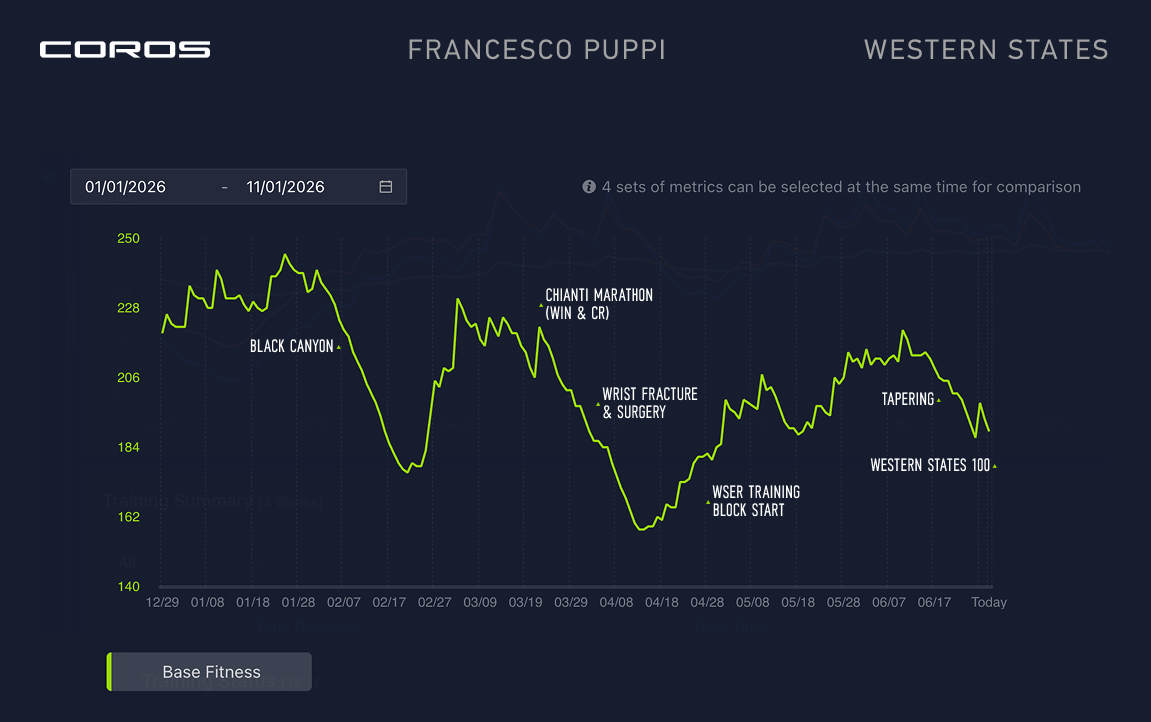
Francesco Puppi's Training Load progression from January 1 to Western States 100.
Start to Foresthill: Staying Controlled in a Record-Pace Race
The race started faster than Francesco expected. Hans Troyer drove the early pace, and several major contenders were pulled into an aggressive rhythm. Francesco knew the effort was risky, but letting the group go carried its own danger.
“The pace was quite fast from the start,” he said. “I told Kilian, Jim and Vincent, who were around me, that to me it felt more like a 100K pace than a 100-mile pace. I knew we were going to be in trouble, but nobody was willing to slow down and I was not willing to let them go. I knew that at some point I'd start to struggle. I just didn't know where.”
That sentence captures the tension of the first half of the race. Francesco understood the cost, but he also understood the level of the field. He stayed close enough to remain dangerous without needing to control the race from the front.
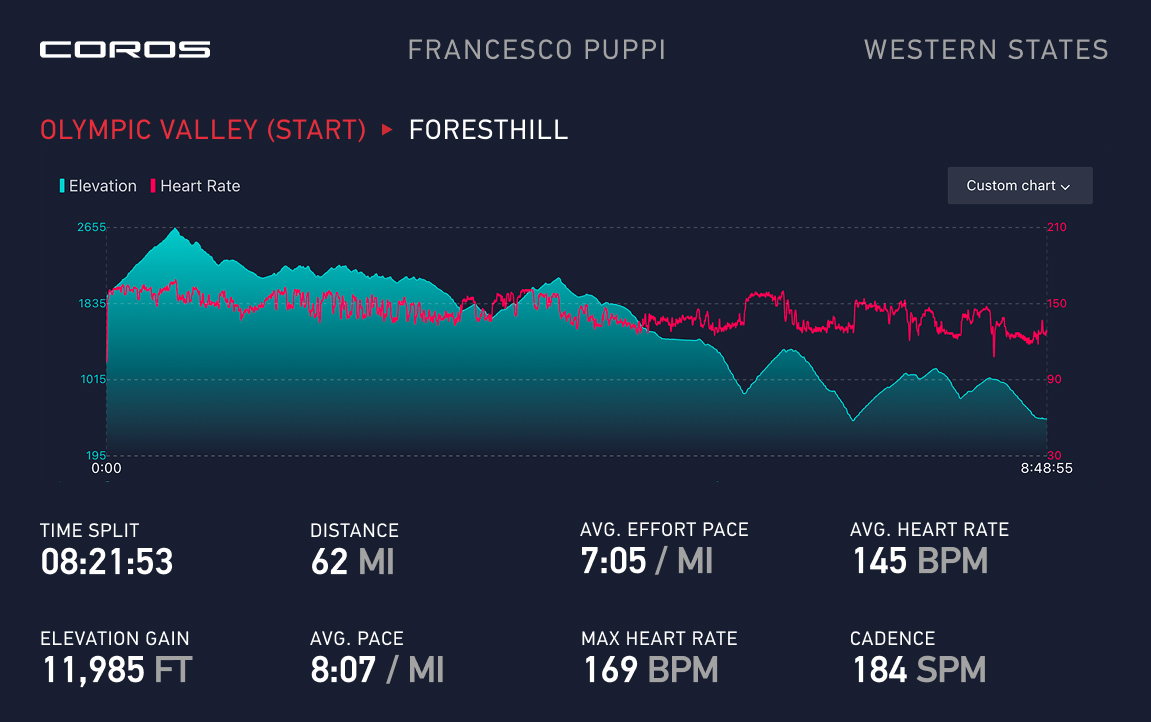
Francesco Puppi's race data from Olympic Valley (Start) to Foresthill (mile 62).
Let's take a closer look at the section from El Dorado Creek to Foresthill, where Francesco's move toward the front began to take shape. The key shift came after Michigan Bluff: over the final 6.3 miles into Foresthill, Francesco made up nearly three minutes on Hans Troyer, reducing the gap from 3:05 to just 15 seconds. His heart rate rose slightly on the climb toward Foresthill, but it remained controlled. At the same time, his Effort Pace shows a strong, sustained uphill output rather than a reckless surge. Before the course became faster and more runnable, Francesco had already used this section to bring himself back to the front of the race.
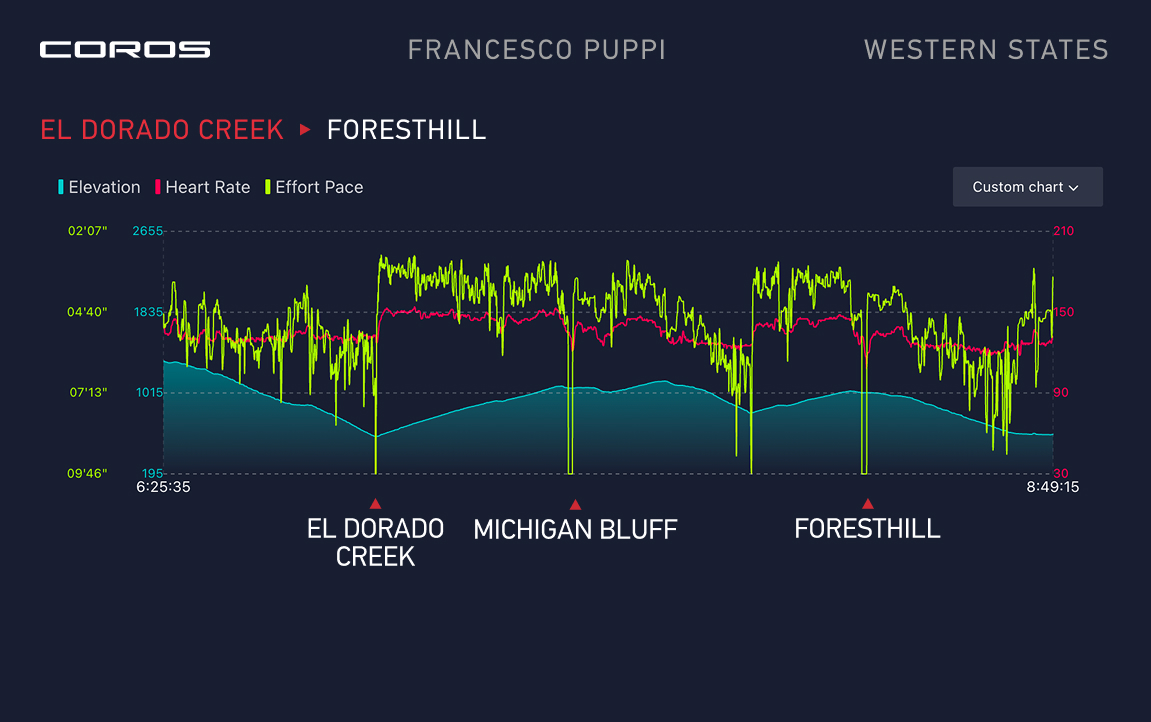
Zooming in on the El Dorado Creek to Foresthill section, where the race dynamics began to shift.
Foresthill to Rucky Chucky: Entering Unknown Territory
Francesco had never raced 100 miles before, and Foresthill marked the edge of what he knew. Until then, the distance still belonged to a world he understood. Beyond that point, every mile was new.
“A 100-mile debut is both an advantage and a disadvantage” he said.
“You don't know exactly the effort and pain involved, and I think that can be an advantage. If you actually know what it feels like, your mind tries to prevent you from going back to that painful place. However, if you want to win, you do have to put yourself in that situation. In my case, I had everything to discover and nothing to lose. It's also a disadvantage because experience is very important for this kind of race.”
Despite being new to the distance, Francesco was moving onto terrain he knew well. After Foresthill, the course begins to overlap with trails from Canyons 100K, where he set the course record in 2025. The distance was unknown, but the terrain was familiar. As the race became faster and more runnable, it played into Francesco's strengths while also increasing the mechanical cost on already-fatigued legs.
Francesco passed Hans after Foresthill and opened a lead that was close to 10 minutes by Rucky Chucky. He did it without a pacer, which made the section more demanding mentally as well as physically.
“After Foresthill, not having a pacer became difficult,” he said. “The day started to feel really long.”
The remoteness of the course also stood out.
“It feels so remote, especially if I compare it to races in Europe I'm used to. Over there, it's just you and the trails around you.”
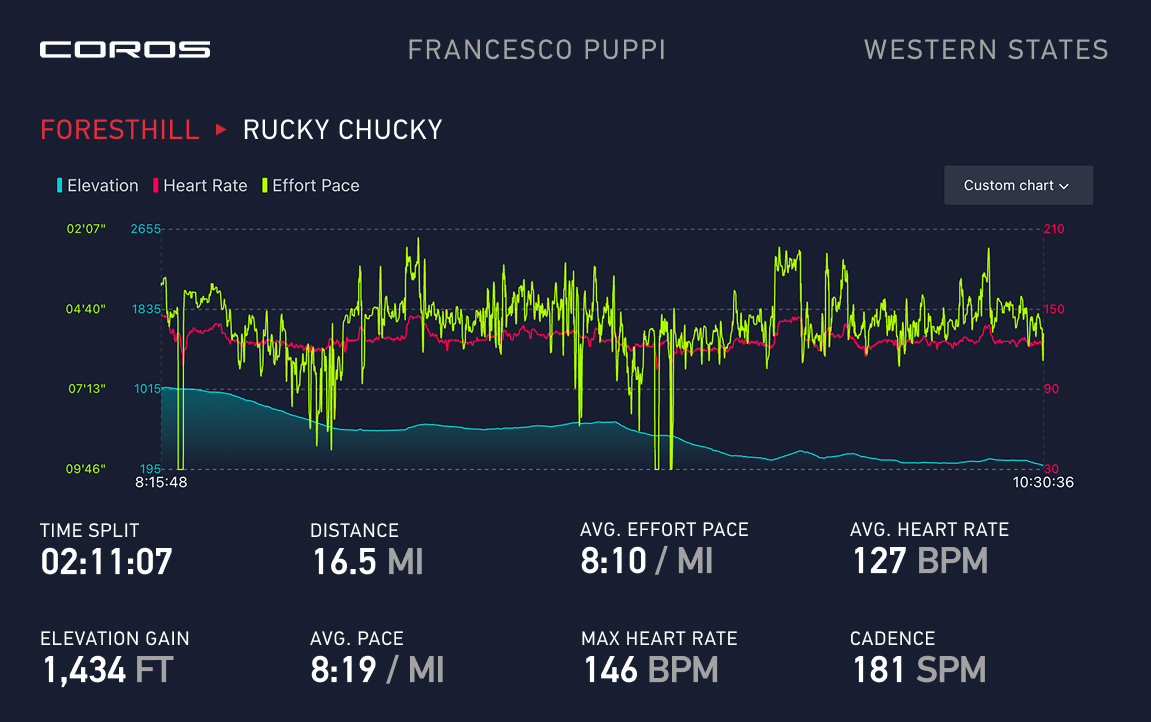
Francesco Puppi's race data from Foresthill (mile 62) to Rucky Chucky (mile 78).
River Crossing to the Finish: Still Running Into History
From the river crossing, roughly 22 miles and 3,740 feet of climbing remained. The section starts with the difficult climb to Green Gate, then transitions into some of the most runnable terrain of the race. That sounds favorable for a fast runner, but after more than 125 kilometers, runnable terrain becomes a biomechanical test. The legs have to keep turning over when the damage from earlier descents and canyon climbs has already accumulated.
This is where Vincent Bouillard made the decisive move. He closed to within 1:30 at Auburn Lake Trails, then moved into the lead before Quarry Road. But Francesco did not collapse. He continued to run at a historic level, covering the river-to-finish section in around 3h15 and finishing well under the previous course record.
The final miles showed both sides of elite 100-mile racing: one athlete producing an exceptional close, and another holding together a debut that had already changed the standard.
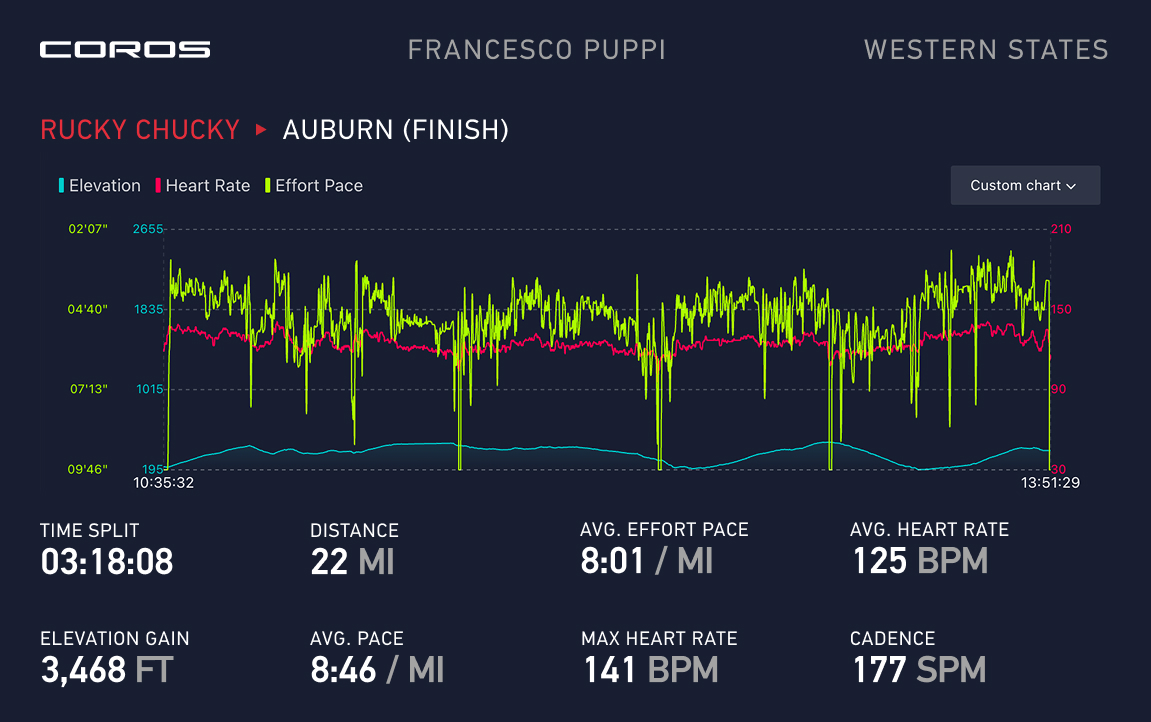
Francesco Puppi's race data from Rucky Chucky (mile 78) to Auburn (Finish).
Francesco Puppi's first 100-mile race became one of the fastest performances in Western States history. He arrived with speed, adapted through uncertainty, moved into the lead beyond 100K, and kept running under record pace deep into the unknown.
For more context on the journey behind this build, read Francesco's FEARLESS story, The Weight of Expectations, or watch his YouTube video, GOING FURTHER - The Roller Coaster, which explores the injuries, uncertainty, and patience that shaped his preparation.